

What are rack and pinion systems for robotics?
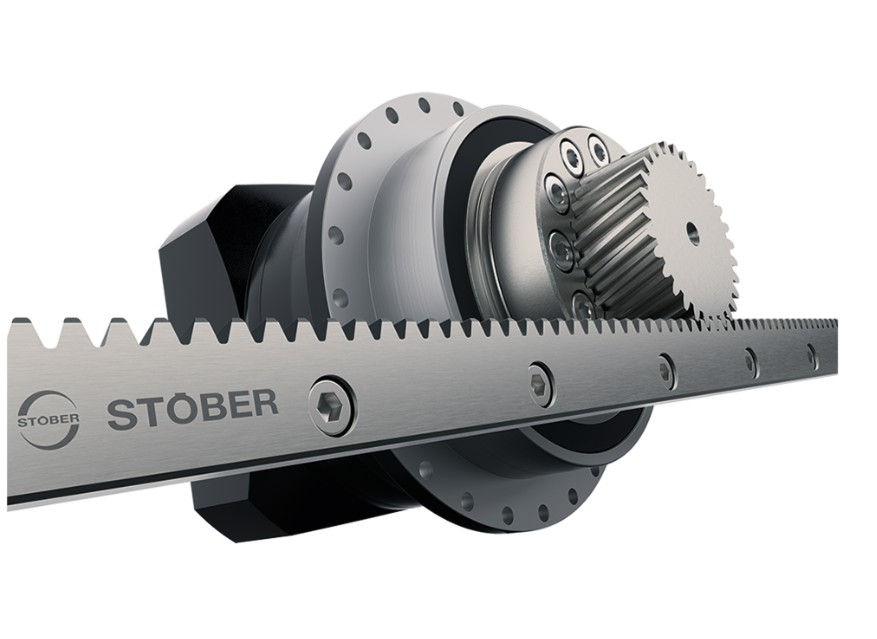
At its simplest, a rack and pinion system converts rotary motion into controlled linear motion. A rotating pinion gear and stationary gear rack connect, causing the carriage or machine component joined to the rack to move in a straight line.
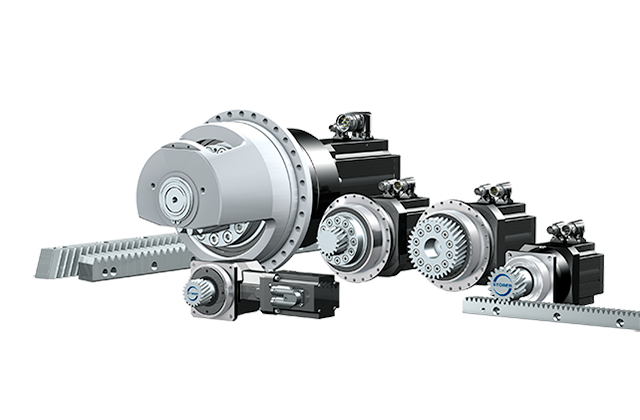
Unlike some other linear drive technologies that become less practical over long distances, rack-and-pinion designs can be scaled for large machines — while maintaining reliable performance. The primary components include:
- Rack
- Pinion gear
- Gearbox
- Servo motor
- Mounting structure
- Motion control system
How the system works
The pinion mechanism begins with a servo motor generating rotational force. That motion passes through a gearbox before reaching the pinion gear. As the gear rotates, its gear teeth engage with the rack, creating smooth, controlled travel along the machine axis. This straightforward mechanical design delivers consistent force throughout the length of travel, making it well-suited for applications requiring both speed and repeatability.
Why robotics uses rack-and-pinion drives
Many robotic rack and pinion systems are designed for machines that travel several feet (or even several meters) without sacrificing positioning consistency.
Compared to belts, ball screws, linear motors, and similar components, rack systems often offer advantages for larger automation equipment — combining long travel capability with mechanical strength and relatively simple maintenance. They also integrate well with modern industrial robotic motion control platforms, allowing servo motors to regulate speed and acceleration along with positioning.
Straight vs. helical rack designs
Straight racks feature teeth that run perpendicular to the rack, making them a practical solution for many applications. A helical rack uses angled teeth that engage more gradually, typically resulting in smoother operation, quieter performance, improved load sharing, and reduced vibration. Helical designs can also contribute to low backlash — an important characteristic for systems that demand consistent positioning accuracy.
Many manufacturers pair these designs with servo-driven rack systems for even greater motion control and responsiveness.
Advantages of rack and pinion systems in robotic automation
Automation equipment often needs to move faster and more frequently than traditional machine designs. That’s where rack-and-pinion technology stands out.
Long travel without compromising performance
Some linear drive technologies become more difficult or expensive as travel distances grow. Rack systems avoid many of those practical limitations, making them an excellent option for large automation platforms. They’re especially useful in robotic linear motion systems that span long machine axes or service multiple workstations within a production line.
Repeatable positioning for demanding automation
Many rack and pinion positioning systems are designed to deliver highly repeatable movement over thousands — or even millions — of operating cycles. That consistency benefits applications such as:
- Pick-and-place equipment
- Automated assembly
- Packaging machinery
- Palletizing
- Material handling
- Large-format machine automation
Reliable, precise positioning helps improve product quality while reducing cycle variability.
Speed and mechanical efficiency
Manufacturers are constantly looking for ways to increase throughput without sacrificing accuracy. Properly engineered rack and pinion gearbox systems support high-speed robotic motion, efficiently transferring torque from the motor to the moving axis. Since the mechanical design remains relatively simple, these systems can maintain performance even during rapid acceleration and deceleration.
Compact integration with modern automation
Today’s automation equipment often combines multiple motion technologies into a single machine. Rack drives integrate easily with motors, sensors, controllers, and safety systems while keeping the overall architecture manageable. Many OEMs also incorporate precision rack systems into modular machine designs that can expand as production requirements grow.
Built for continuous operation
Proper lubrication and alignment, along with quality components, allow rack systems to support continuous-duty operation and high cycle counts with minimal maintenance. Durable gear geometry and precision manufacturing also contribute to longer service life — helping reduce unexpected downtime.
Key engineering considerations when selecting rack and pinion systems for robotics
Every application has unique performance requirements that influence a few key areas, including sizing, component selection, and overall system design. Key factors include:
- Load capacity
- Travel distance
- Required speed and acceleration
- Positioning accuracy
- Operating environment
- Servo motor and gearbox selection
Load, speed, and travel requirements
Engineers should first evaluate how much weight the system must move and how quickly it needs to accelerate, along with how far it will travel. These factors determine the correct rack size, gear dimensions, motor requirements, and overall system stiffness. Oversizing adds unnecessary cost, while undersizing can shorten equipment life and reduce performance.
Backlash, stiffness, and motion quality
Even small amounts of backlash can affect synchronized automation systems. Applications requiring coordinated movement between multiple axes benefit from carefully engineered gearing that minimizes lost motion while maintaining smooth operation. Stiff mechanical connections also improve repeatability during rapid acceleration and frequent direction changes.
Gearboxes and servo integration
A well-designed robotic motion gearbox plays an important role in overall system performance. Proper servo gearbox integration allows engineers to match motor characteristics with application requirements — while optimizing torque and speed, along with inertia. Many manufacturers also offer complete robotic gearbox systems that simplify installation and commissioning.
Rack geometry and environmental conditions
Rack pitch, tooth profile, gear geometry, and similar factors all influence load distribution and motion smoothness. Environmental conditions also matter: dust, washdown requirements, vibration, extreme temperatures, and continuous-duty operation can all affect long-term reliability. Proper mounting rigidity and alignment help reduce wear while preserving accuracy throughout the system’s service life.
Integrated rack and pinion drives can further simplify machine design, bringing compatible components together into a cohesive motion solution.
Common robotics applications for rack and pinion systems
Rack-and-pinion technology supports a range of industrial automation equipment, since it combines speed and durability with scalable travel lengths.
Gantry and material handling automation
Large robotic gantry systems frequently rely on rack drives to move heavy payloads across long distances while maintaining consistent motion. These systems are commonly found in:
- Warehouse automation
- Automated storage systems
- Assembly lines
- Packaging equipment
- CNC machine tending
- End-of-line palletizing
Their ability to provide repeatable long-axis travel makes them especially valuable for high-throughput operations.
Industries that depend on rack-and-pinion motion
Many rack and pinion robotics applications are found in industries where production demands both precision and reliability. Automotive manufacturers use them for assembly automation, while packaging facilities rely on them for high-speed product movement. Semiconductor production, food processing, warehouse fulfillment, and advanced manufacturing also benefit from robust robotics motion systems that operate continuously with minimal downtime.
Choosing the right motion partner
Selecting the right industrial robotic gearbox systems goes beyond comparing specifications. Engineers should evaluate durability, motion accuracy, integration capabilities, and long-term service support alongside component performance. Working with an experienced motion partner can simplify system design while ensuring compatibility between key components: servo motors, gearboxes, and rack assemblies. Modular solutions also make future upgrades and maintenance more straightforward as production needs evolve.
For projects requiring reliable automation performance, STOBER provides integrated motion solutions engineered for demanding applications. The STOBER Configurator helps engineers identify compatible rack-and-pinion components and gearboxes — along with servo solutions — that match specific machine requirements, making it easier to build efficient, scalable automation systems.
 How to choose the right hollow-type output shaft for your application
  Eight warning signs that you need industrial gearbox repair
  STOBER recognized as Maysville Area Chamber’s Large Business of the Year
  Can you repair a gearbox? Signs, costs, and next steps