
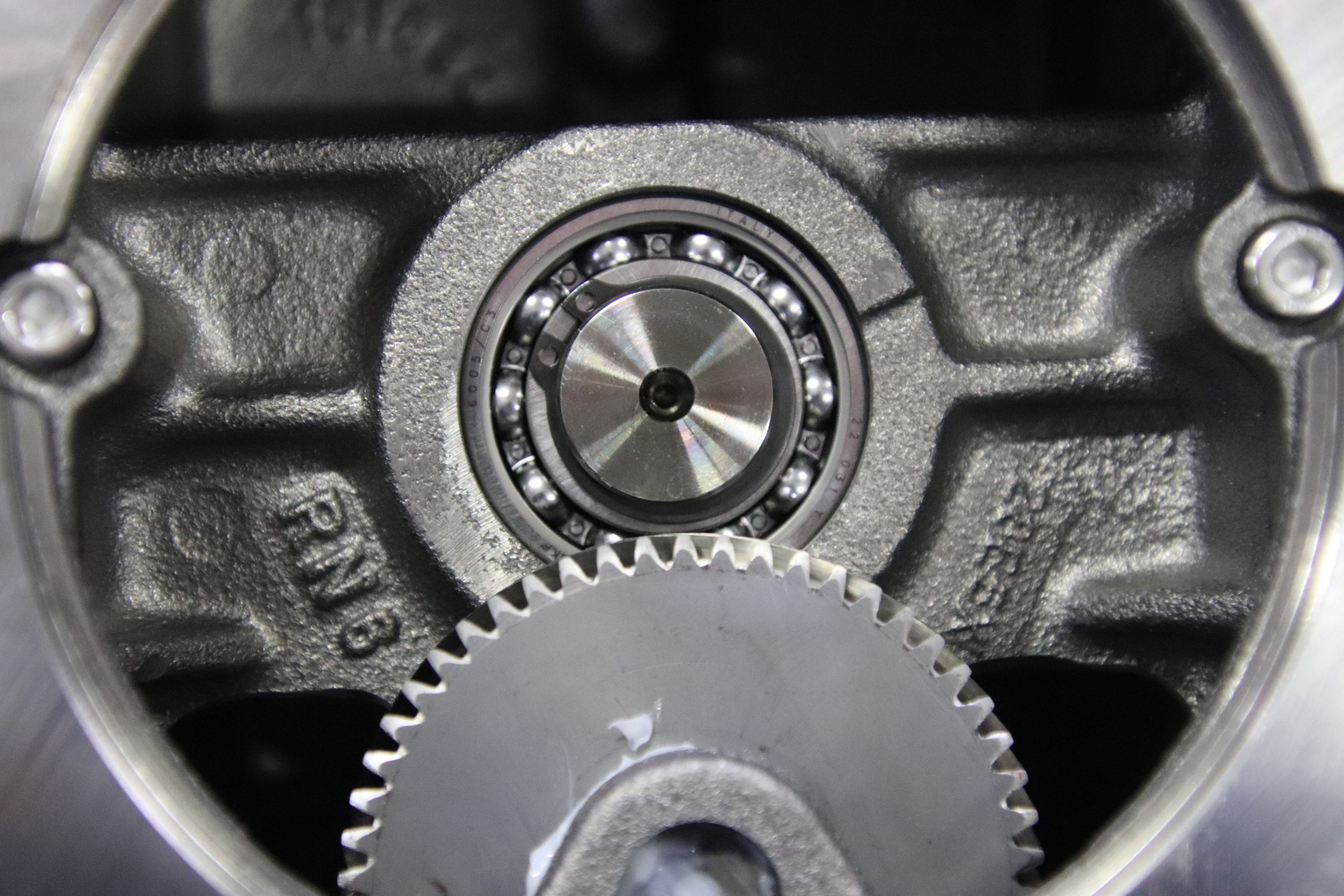
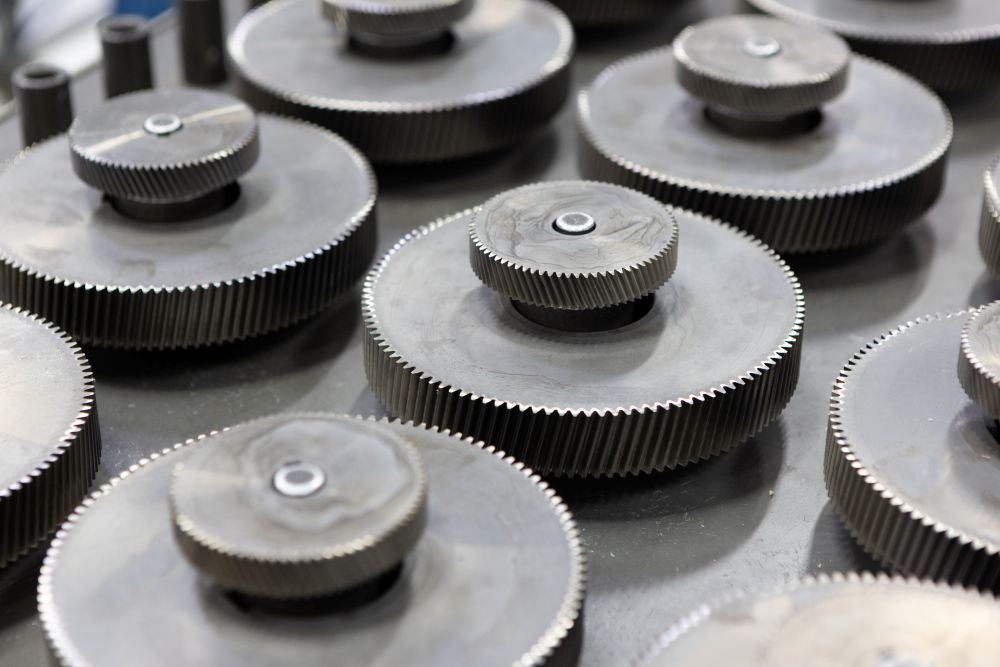
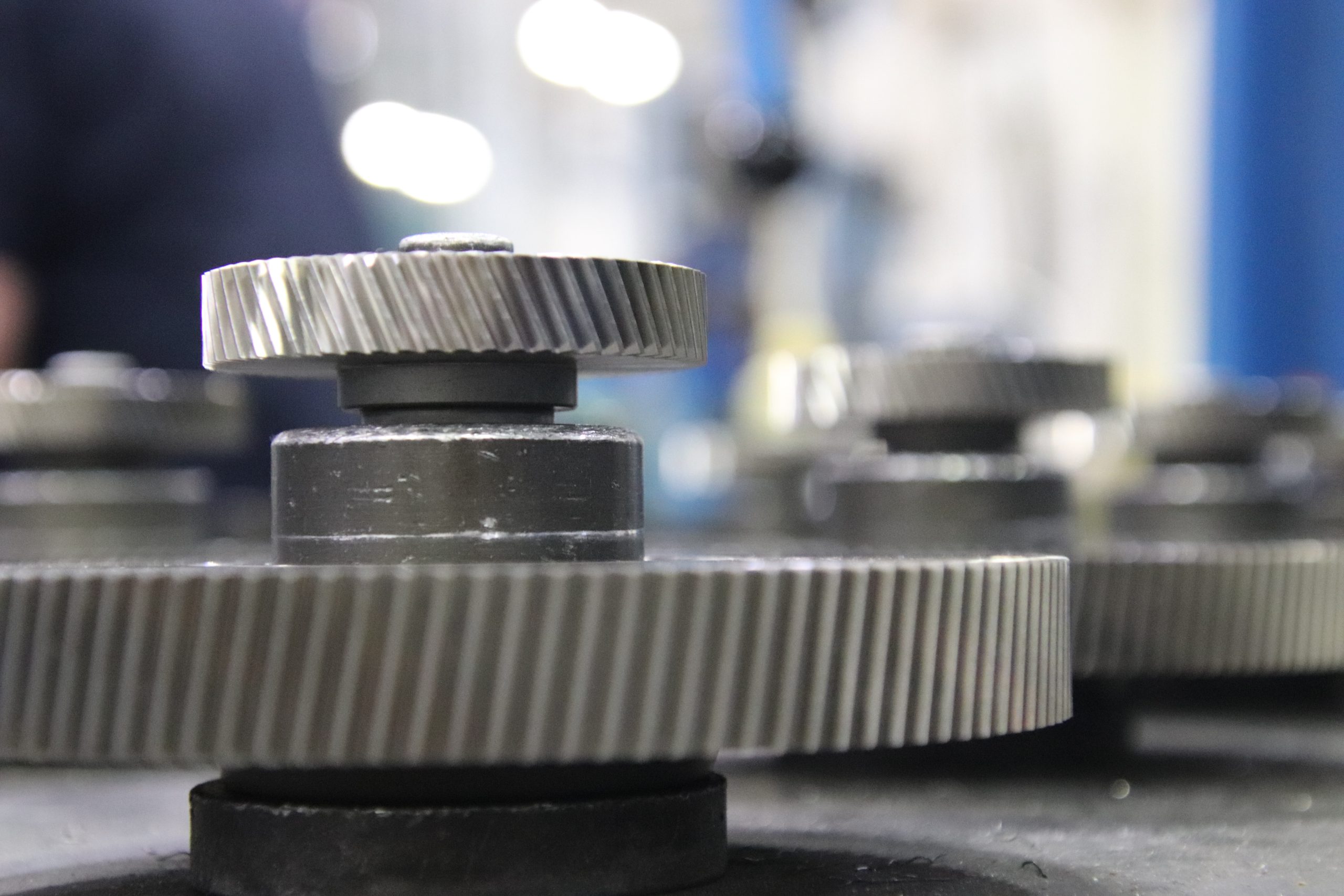
Gear systems show up everywhere in motion control, from robotics and automation to automotive drivetrains and industrial machinery. When these systems reverse direction, a small delay or looseness can appear before motion transfers fully. That behavior is known as gear backlash.
In simple terms, backlash is the slight movement that happens before gears fully re-engage after a direction change. But what is gear backlash in engineering terms? This concept is tied to a controlled mechanical gap that prevents binding and allows smooth operation under varying loads and temperatures.
A more formal gear backlash definition describes it as the intentional clearance between meshing components that allows controlled movement between engaging surfaces. That gear clearance exists between mating gears and only becomes noticeable during reversal. The gap between meshing gear teeth is influenced by design factors, such as tooth thickness, that determine how tightly or loosely the system engages.
Backlash is usually measured in a couple of ways. Engineers often measure gear backlash using angular displacement in degrees or arcminutes, or linear movement at the pitch circle, depending on system geometry. In precision systems, even small deviations can make a difference when evaluating motion response.
What matters most is separating physical clearance from effect. The clearance is built into the system, while the result is a short delay in motion transfer that can affect accuracy during direction changes.
Why gear backlash exists in mechanical systems
Backlash exists because real systems can’t operate without space for variation. The need for controlled clearance comes from both design limits and operating conditions.
General properties include:
- Manufacturing variation that requires allowance for consistent assembly
- Gear tolerance differences that ensure parts still function across production ranges
- Thermal expansion that changes component size during operation
- Lubrication that needs space to form a stable film
- Load forces that introduce slight deflection in shafts and supports
- Assembly variation and mounting distance shifts that affect engagement
These factors all contribute to what causes gear backlash in real machines. The broader causes of backlash in gears also include long-term wear and slight misalignment that develop over time. Even well-built systems gradually shift as components settle under load cycles, so designers need to account for both initial and operational changes.
Without this designed-in clearance, systems would bind under heat and stress or misalignment. That’s why gear tolerance plays such an important role: It defines how much variation is acceptable before performance is affected. Even specialized systems, like a worm gearbox, rely on this controlled spacing to avoid excessive friction and premature wear.
In practice, the designed clearance associated with backlash also improves system resilience during repeated load reversals, where forces fluctuate throughout operation. That variability would otherwise create unpredictable stress concentrations across contact surfaces.
It also helps systems remain stable in environments where vibration or structural movement is unavoidable, since perfect alignment is rarely maintained once a machine is running in real conditions.
How gear backlash affects performance and accuracy
Backlash becomes most visible when motion reverses direction. The system must first move through the internal gap before torque is fully transmitted again. In backlash in motion control systems, this delay shows up as a short lag between input and output response. That lag directly affects positioning accuracy, especially in systems requiring repeatable motion.
The backlash impact on precision becomes more noticeable as systems grow in size or complexity. Small angular gaps can turn into measurable positional deviations over longer travel distances or multi-stage gear systems. In real operation, backlash doesn’t act alone. It interacts with stiffness and load direction, along with control behavior. When a system reverses, there’s often a brief phase where mechanical components, sensors, and control loops are effectively catching up to each other before steady motion resumes.
Another layer that often gets overlooked is system inertia. Heavier loads resist direction changes more noticeably, making backlash feel either sharper or more delayed depending on acceleration profiles. That means two identical gear systems can behave differently simply because of what they’re driving.
Wear and tear that occur over time also have a noticeable effect. Even small increases in clearance may not be obvious in early operation, but they can slowly shift calibration, especially in systems that rely on tight repeatability over long duty cycles. Reducing backlash too aggressively, though, introduces its own problems. Tight systems may behave well initially but become sensitive to temperature variation, where small expansions create binding or uneven contact pressure.
In high-performance machines, engineers also monitor how vibration patterns change over time, since increasing backlash often shows up first as subtle noise before measurable accuracy loss appears. Over extended operation, even lubrication breakdown can influence backlash behavior, since reduced film stability changes how smoothly mating surfaces transition during direction changes.
In practice, engineers are constantly balancing responsiveness, durability, and stability rather than aiming for a single ideal condition.
Backlash vs. lost motion: Understanding the difference
Backlash and lost motion are often confused, but they describe different levels of behavior in a system. Here’s a key difference between backlash and lost motion: the former is component-level, while the latter is system-level.
Other differences include:
- Backlash is the physical clearance between meshing components.
- Lost motion includes backlash plus system deformation.
- Structural flex, coupling compliance, and deflection all contribute to lost motion.
In real systems, lost motion becomes more meaningful since it reflects how the entire drivetrain behaves, not just one interface. Even if backlash is reduced through tighter machining or preload, other sources of compliance can still produce measurable output delay.
For example, long shafts, flexible couplings, mounting structures, and other components can all introduce small elastic responses that add up under load. That’s why system-level analysis is often required for handling total lost motion and precision motion design rather than relying solely on gear specifications.
This broader view becomes especially important in high-accuracy applications where multiple small effects stack together in ways that aren’t immediately visible at the component level. It also helps engineers avoid over-correcting one variable while ignoring others, unintentionally making system behavior less stable rather than more precise.
How engineers reduce or control gear backlash
Engineers rarely eliminate backlash completely; they manage it instead. Better manufacturing precision helps ensure more consistent gear engagement, reducing variation in motion behavior. But mechanical control methods are usually where most of the practical improvement happens.
Systems using anti-backlash gears apply preload, so both sides of the gear interface remain engaged, reducing free movement during direction changes. This creates a more consistent transfer of motion, especially in low-speed or high-precision applications.
System architecture also plays a major role in how to reduce backlash in gears. Designs using planetary gearboxes distribute load across multiple contact points, improving stiffness and reducing the visible effect of backlash during operation. In some cases, engineers also use compensation techniques at the control level. Motion controllers can predict delay during reversal and adjust command signals, so output motion feels smoother and more responsive without modifying the mechanical system itself.
Material choice and surface treatment also matter more than they first appear. Over time, wear patterns can gradually increase clearance, so selecting materials that maintain stable contact behavior can significantly extend performance consistency. All of this falls under backlash control in gear systems, where mechanical and control strategies are combined rather than treated separately.
In more advanced design environments, engineers often evaluate multiple reduced backlash solutions together instead of relying on a single solution. That might include preload, structural reinforcement, motion tuning, and other methods working together, depending on performance targets.
When gear backlash matters most in real-world applications
Backlash doesn’t affect every system equally. Instead, its importance depends on precision requirements and motion behavior.
- High-precision systems (for example, robotics, CNC machines, aerospace equipment, and medical devices) are highly sensitive, since small errors affect output accuracy.
- These systems require strict acceptable gear backlash tolerance levels to maintain repeatability.
- Heavy-duty systems (for example, conveyors or lifting equipment) prioritize strength over fine positioning.
- Frequent direction changes make backlash more noticeable.
- Longer motion paths amplify small errors into larger deviations.
In practice, engineers evaluate backlash based on application demands rather than a fixed rule. A system that performs well in one environment may behave very differently in another depending on load, speed, accuracy, and other expectations.
Designing around gear backlash in modern motion systems
Modern motion systems don’t treat backlash as a standalone issue; it’s handled as part of a full system design where mechanics and controls are developed together. Engineers look at how motors, gearboxes, structure, and other components interact, so the system behaves predictably under real conditions, not just ideal ones.
Within this approach, factors like alignment and stiffness, along with mounting distance, all influence how motion is transmitted. Even small variations can affect response in precision setups.
To evaluate performance more realistically, engineers also consider system-wide behavior involving mating teeth engagement and mating gear interaction, since these relationships define how smoothly motion transfers through the drivetrain. Overall, rather than targeting the complete elimination of backlash, the goal is to manage it in a way that supports accuracy, durability, and efficiency.
Turning understanding into better motion performance
Gear backlash is a fundamental part of how mechanical systems function, not a flaw to eliminate entirely. The real goal isn’t to remove backlash, but to understand how it behaves within a system and design around it in a way that supports performance, reliability, and accuracy.
When engineers take a system-level approach, they’re better equipped to balance clearance, stiffness, control response, and long-term durability. That’s what leads to consistent motion, predictable results, and reduced maintenance over time.
Whether you’re designing high-precision equipment or optimizing an existing application, understanding gear backlash helps you make smarter decisions about component selection, system architecture, and control strategy.
Ready to optimize your motion system?
If you’re evaluating how backlash impacts your application, or looking for ways to improve accuracy and performance, STOBER can help. Our team of engineers can help you identify the right gearbox, motor, and motion solution for your specific requirements.
Explore our gearing solutions or connect with an expert to start improving your system performance today.
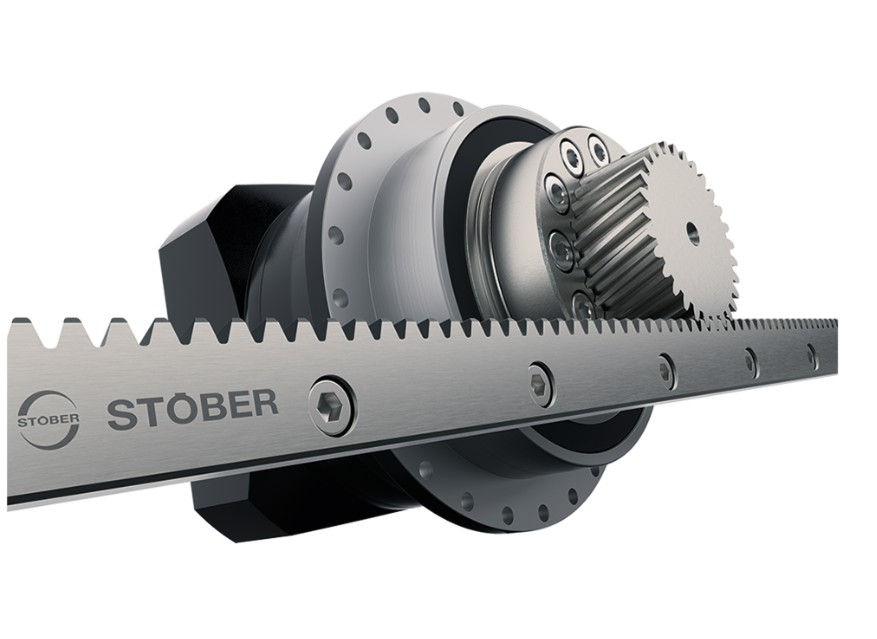 Rack and pinion systems for robotics: Benefits, design, and applications
 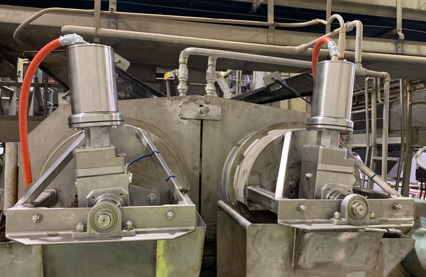 STOBER’s stainless steel solution helps food processor improve reliability in harsh washdown environment
  The science of gear tooth design: How geometry impacts performance